tgen
Loading...
Searching...
No Matches
tgen::wgraph< VWeight, EWeight >::value

Labeled graph value. More...

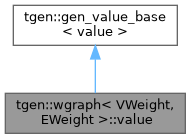
Inheritance diagram for tgen::wgraph< VWeight, EWeight >::value:

Public Member Functions

 value (const std::vector< std::set< int > > &adj, bool is_directed=false)
 Builds a graph from an adjacency list.
 value (int n, const std::vector< std::pair< int, int > > &edges={}, bool is_directed=false)
 Builds a graph from number of vertices and edge list.
 value (const typename wtree< VWeight, EWeight >::value &t)
 Builds an undirected graph from a tree.
int n () const
 Number of vertices.
int m () const
 Number of edges.
bool is_directed () const
 If the graph is directed.
const std::vector< std::set< int > > & adj () const
 Adjacency list.
const std::vector< std::pair< int, int > > & edges () const
 Edge list.
const std::optional< std::vector< VWeight > > & vertex_weights () const
 Optional vertex weights.
const std::optional< std::vector< EWeight > > & edge_weights () const
 Optional edge weights.
template<typename NewVWeight = VWeight>
wgraph< NewVWeight, EWeight >::value set_vertex_weights (const std::vector< NewVWeight > &vertex_weights) const
 Attaches vertex weights.
template<typename NewEWeight = EWeight>
wgraph< VWeight, NewEWeight >::value set_edge_weights (const std::vector< NewEWeight > &edge_weights) const
 Attaches edge weights.
valueedge_weighted ()
 Enables edge-weighted mode on an edgeless graph.
valueadd_1 ()
 Adds 1 for printing.
valueprint_nm ()
 Prints number of vertices and edges before edge list.
valueshuffle_except (std::set< int > indices)
 Shuffles vertices except given vertices, and edge order.
valueshuffle ()
 Shuffles all vertices and edge order.
valueadd_vertices (int k, std::optional< std::vector< VWeight > > new_vertex_weights=std::nullopt)
 Adds new isolated vertices.
valueadd_edge (int u, int v, std::optional< EWeight > w=std::nullopt)
 Adds an edge between two vertices.
valuelink (const value &rhs, int new_u, int new_v, std::optional< EWeight > new_w=std::nullopt)
 Links two graphs by an new edge.
valueglue (const value &rhs, std::set< std::pair< int, int > > index_pairs)
 Glues another graph at given vertex pairs.
valueglue (const value &rhs, std::set< int > indices)
 Glues another graph at given vertices.
valuedisjoint_union (const value &rhs)
 Disjoint union with another graph.
valuerandom_subgraph (int num_edges)
 Random subgraph with a fixed number of edges.
valuerandom_connected_subgraph (int num_edges)
 Random subgraph with a fixed number of edges that keeps components connected.
value operator! () const
 Graph complement of unweighted graph.
value operator+ (const value &rhs) const
 Concatenates two graphs (disjoint union).
std::tuple< int, int, std::vector< std::set< int > > > to_std () const
 Converts the graph to std types.
Public Member Functions inherited from tgen::gen_value_base< value >
bool operator< (const value &rhs) const

Friends

std::ostream & operator<< (std::ostream &out, const value &val)
 Prints the graph to an output stream.

Detailed Description

template<typename VWeight, typename EWeight>
struct tgen::wgraph< VWeight, EWeight >::value

Labeled graph value.

Adjacency lists are symmetric for undirected graphs; the edge list tgen::wgraph::value::edges lists each undirected edge once as (u, v) with u <= v. Directed graphs list each directed edge once.

It can be printed through std::cout.

Definition at line 5157 of file tgen.h.

Constructor & Destructor Documentation

◆ value() [1/3]

template<typename VWeight, typename EWeight>
tgen::wgraph< VWeight, EWeight >::value::value ( const std::vector< std::set< int > > & adj,
bool is_directed = false )
inline

Builds a graph from an adjacency list.

Parameters
adjAdjacency list; adj[u] contains every neighbor of u (out-neighbors if directed).
is_directedIf false, adj must be symmetric and each undirected edge must appear in both directions.

Complexity

O(n + m).

Examples

// Triangle as undirected graph from adjacency.
std::vector<std::set<int>> a(3);
a[0] = {1, 2};
a[1] = {0, 2};
a[2] = {0, 1};
tgen::graph::value g(a);

Definition at line 5176 of file tgen.h.

◆ value() [2/3]

template<typename VWeight, typename EWeight>
tgen::wgraph< VWeight, EWeight >::value::value ( int n,
const std::vector< std::pair< int, int > > & edges = {},
bool is_directed = false )
inline

Builds a graph from number of vertices and edge list.

Parameters
nNumber of vertices.
edgesList of edges.
is_directedIf the graph is directed.

For undirected graphs, each edge (u, v) should appear once with u <= v.

Complexity

O(n + m log n).

Examples

// 2 P_2.
tgen::graph::value g(4, {{0, 1}, {2, 3}});

Definition at line 5197 of file tgen.h.

◆ value() [3/3]

template<typename VWeight, typename EWeight>
tgen::wgraph< VWeight, EWeight >::value::value ( const typename wtree< VWeight, EWeight >::value & t)
inline

Builds an undirected graph from a tree.

Parameters
tTree to convert.

The result has the same vertices and edges as t, with is_directed() == false. Vertex and edge weights are copied when the weight types match.

Complexity

O(n).

Examples

auto t = tgen::tree(5).gen();
auto g = tgen::graph::value(t);
wtree< int, int > tree
Unweighted labeled trees.
Definition tgen.h:4981
value gen() const
Generates a uniformly random value from the set of valid trees.
Definition tgen.h:4883

Definition at line 5228 of file tgen.h.

Member Function Documentation

◆ add_1()

template<typename VWeight, typename EWeight>
value & tgen::wgraph< VWeight, EWeight >::value::add_1 ( )
inline

Adds 1 for printing.

This makes it so, when given to std::cout, the graph will be printed with labels 1-based. Weights are not affected.

Complexity

O(1).

Examples

// Stream edges with vertex indices shifted by one for output only.
auto g = tgen::graph::value(3, {{0, 1}, {1, 2}});
std::cout << g.add_1(); // Prints "1 2\n2 3\n".

Definition at line 5326 of file tgen.h.

◆ add_edge()

template<typename VWeight, typename EWeight>
value & tgen::wgraph< VWeight, EWeight >::value::add_edge ( int u,
int v,
std::optional< EWeight > w = std::nullopt )
inline

Adds an edge between two vertices.

Parameters
uFirst endpoint (tail if directed).
vSecond endpoint (head if directed).
wOptional edge weight (required iff the graph already has edge weights).

If the edge is already present, does nothing.

Complexity

O(log n) amortized.

Examples

// Add a second edge; edge count becomes two.
tgen::graph::value g(3, {{0, 1}});
g.add_edge(1, 2);
std::cout << g.m() << std::endl; // Prints "2".

Definition at line 5441 of file tgen.h.

◆ add_vertices()

template<typename VWeight, typename EWeight>
value & tgen::wgraph< VWeight, EWeight >::value::add_vertices ( int k,
std::optional< std::vector< VWeight > > new_vertex_weights = std::nullopt )
inline

Adds new isolated vertices.

Parameters
kNumber of vertices to append.
new_vertex_weightsOptional weights for the new vertices (required if the graph already has vertex weights).

Complexity

O(k) amortized.

Examples

// Append one isolated vertex; total vertex count becomes three.
tgen::graph::value g(2, {{0, 1}});
g.add_vertices(1);
std::cout << g.n() << std::endl; // Prints "3".

Definition at line 5414 of file tgen.h.

◆ adj()

template<typename VWeight, typename EWeight>
const std::vector< std::set< int > > & tgen::wgraph< VWeight, EWeight >::value::adj ( ) const
inline

Adjacency list.

Returns
Constant reference to the adjacency list.

Examples

// Degree of vertex 1 in a P_3.
auto g = tgen::graph::value(3, {{0, 1}, {1, 2}});
std::cout << g.adj()[1].size() << std::endl; // Prints "2".

Definition at line 5267 of file tgen.h.

◆ disjoint_union()

template<typename VWeight, typename EWeight>
value & tgen::wgraph< VWeight, EWeight >::value::disjoint_union ( const value & rhs)
inline

Disjoint union with another graph.

Complexity

O(rhs.n + rhs.m log n) amortized.

That is, the complexity depends mostly on the rhs graph.

Examples

// Disjoint union of two P_2.
tgen::graph::value a(2, {{0, 1}});
tgen::graph::value b(2, {{0, 1}});
a.disjoint_union(b);
std::cout << a.n() << std::endl; // Prints "4".

Definition at line 5579 of file tgen.h.

◆ edge_weighted()

template<typename VWeight, typename EWeight>
value & tgen::wgraph< VWeight, EWeight >::value::edge_weighted ( )
inline

Enables edge-weighted mode on an edgeless graph.

After this call, add_edge(u, v, w) accepts a weight for each new edge.

Precondition
The graph has no edges (m() == 0).

Complexity

O(1).

Examples

// Build a weighted directed graph edge by edge.
tgen::egraph<int>::value g(3, {}, true);
g.edge_weighted();
g.add_edge(0, 1, 10);
g.add_edge(1, 2, 20);
std::cout << g; // Prints "0 1 10\n1 2 20\n".

Definition at line 5313 of file tgen.h.

◆ edge_weights()

template<typename VWeight, typename EWeight>
const std::optional< std::vector< EWeight > > & tgen::wgraph< VWeight, EWeight >::value::edge_weights ( ) const
inline

Optional edge weights.

Returns
Constant reference to the optional edge-weight vector, aligned with edges().

Index i corresponds to edges()[i]. Absent when the tree has no edge weights.

Examples

// First edge weight aligned with the edge list order.
auto g = tgen::graph::value(3, {{0, 1}, {1, 2}}).set_edge_weights({30, 40});
std::cout << (*g.edge_weights())[0] << std::endl; // Prints "30".
wgraph< VWeight, NewEWeight >::value set_edge_weights(const std::vector< NewEWeight > &edge_weights) const
Attaches edge weights.
Definition tgen.h:5302

Definition at line 5281 of file tgen.h.

◆ edges()

template<typename VWeight, typename EWeight>
const std::vector< std::pair< int, int > > & tgen::wgraph< VWeight, EWeight >::value::edges ( ) const
inline

Edge list.

Returns
Constant reference to the edge list.

Examples

// List every edge of a path on four vertices.
for (const auto &[u, v] : tgen::graph::value(4, {{0, 1}, {1, 2}, {2, 3}}).edges())
std::cout << u << " " << v << "\n";

Definition at line 5273 of file tgen.h.

◆ glue() [1/2]

template<typename VWeight, typename EWeight>
value & tgen::wgraph< VWeight, EWeight >::value::glue ( const value & rhs,
std::set< int > indices )
inline

Glues another graph at given vertices.

Parameters
rhsOther graph to be glued.
indicesSet of vertex labels: for each i in indices, vertex i is glued to vertex i in rhs.

Gluing one vertex to another means they are considered to be the same vertex, maintaining the label it had in this graph. Other vertices are shifted accordingly.

Complexity

O(rhs.n + rhs.m log n) amortized.

That is, the complexity depends mostly on the rhs graph.

Examples

// Glues to C_3 at vertex 0.
std::cout << tgen::C(3).glue(tgen::C(3), {0}).n() << std::endl; // Prints "5".
graph::value C(int n, bool is_directed=false)
Cycle graph.
Definition tgen.h:6356
int n() const
Number of vertices.
Definition tgen.h:5258

Definition at line 5566 of file tgen.h.

◆ glue() [2/2]

template<typename VWeight, typename EWeight>
value & tgen::wgraph< VWeight, EWeight >::value::glue ( const value & rhs,
std::set< std::pair< int, int > > index_pairs )
inline

Glues another graph at given vertex pairs.

Parameters
rhsOther graph to be glued.
index_pairsSet of (l, r) pairs: vertex l is glued to vertex r in rhs.

Gluing one vertex to another means they are considered to be the same vertex, maintaining the label it had in this graph. Other vertices are shifted accordingly.

Complexity

O(rhs.n + rhs.m log n) amortized.

That is, the complexity depends mostly on the rhs graph.

Examples

// Glues the edge of a P_3 onto the certer of another P_3.
auto g = tgen::P(3).glue(tgen::P(3), {{0, 1}});
graph::value P(int n, bool is_directed=false)
Path graph.
Definition tgen.h:6345

Definition at line 5502 of file tgen.h.

◆ is_directed()

template<typename VWeight, typename EWeight>
bool tgen::wgraph< VWeight, EWeight >::value::is_directed ( ) const
inline

If the graph is directed.

Returns
True if edges are directed.

Examples

// Directed flag: same edge list, undirected vs directed semantics.
auto u = tgen::graph::value(3, {{0, 1}}, false);
auto d = tgen::graph::value(3, {{0, 1}}, true);
std::cout << u.is_directed() << d.is_directed() << std::endl; // Prints "01".

Definition at line 5264 of file tgen.h.

◆ link()

template<typename VWeight, typename EWeight>
value & tgen::wgraph< VWeight, EWeight >::value::link ( const value & rhs,
int new_u,
int new_v,
std::optional< EWeight > new_w = std::nullopt )
inline

Links two graphs by an new edge.

Parameters
rhsSecond graph.
new_uEndpoint in this graph.
new_vEndpoint in rhs before relabeling.
new_wOptional weight of the connecting edge.

Vertices on rhs are shifted by the current n. Weight usage must be consistent.

Complexity

O(rhs.n + rhs.m log n) amortized.

That is, the complexity depends mostly on the rhs graph.

Examples

// Connect two single-edge graphs with one new bridge edge; four vertices total.
tgen::graph::value a(2, {{0, 1}});
tgen::graph::value b(2, {{0, 1}});
a.link(b, 0, 0);
std::cout << a.n() << std::endl; // Prints "4".

Definition at line 5475 of file tgen.h.

◆ m()

template<typename VWeight, typename EWeight>
int tgen::wgraph< VWeight, EWeight >::value::m ( ) const
inline

Number of edges.

Returns
The number of edges (size of edges()).

Examples

// Edge count of a path on four vertices.
auto g = tgen::graph::value(4, {{0, 1}, {1, 2}, {2, 3}});
std::cout << g.m() << std::endl; // Prints "3".

Definition at line 5261 of file tgen.h.

◆ n()

template<typename VWeight, typename EWeight>
int tgen::wgraph< VWeight, EWeight >::value::n ( ) const
inline

Number of vertices.

Returns
The number of vertices.

Examples

// Vertex count of a path on five vertices.
auto g = tgen::graph::value(5, {{0, 1}, {1, 2}, {2, 3}, {3, 4}});
std::cout << g.n() << std::endl; // Prints "5".

Definition at line 5258 of file tgen.h.

◆ operator!()

template<typename VWeight, typename EWeight>
value tgen::wgraph< VWeight, EWeight >::value::operator! ( ) const
inline

Graph complement of unweighted graph.

Returns
Complement graph.

Immutable style: returns a copy with the complement with the same n, is_directed, and printing flags; does not modify *this.

Self loops are maintained.

Complexity

O(n^2).

Examples

// Complement of a path on 4 vertices has three edges (the missing chords).
tgen::graph::value p = tgen::P(4);
std::cout << (!p).m() << std::endl; // Prints "3".
int m() const
Number of edges.
Definition tgen.h:5261

Definition at line 5708 of file tgen.h.

◆ operator+()

template<typename VWeight, typename EWeight>
value tgen::wgraph< VWeight, EWeight >::value::operator+ ( const value & rhs) const
inline

Concatenates two graphs (disjoint union).

Immutable style: returns a copy with the disjoint union; does not modify *this.

Complexity

O(n + m log n) for the combined size.

Examples

// Concatenate two disjoint edges; total vertex count is four.
tgen::graph::value a(2, {{0, 1}});
tgen::graph::value b(2, {{0, 1}});
std::cout << (a + b).n() << std::endl; // Prints "4".

Definition at line 5742 of file tgen.h.

◆ print_nm()

template<typename VWeight, typename EWeight>
value & tgen::wgraph< VWeight, EWeight >::value::print_nm ( )
inline

Prints number of vertices and edges before edge list.

Complexity

O(1).

Examples

// Stream with a leading line giving vertex count and edge count.
auto g = tgen::graph::value(3, {{0, 1}, {1, 2}});
std::cout << g.print_nm(); // Prints "3 2\n0 1\n1 2\n".

Definition at line 5333 of file tgen.h.

◆ random_connected_subgraph()

template<typename VWeight, typename EWeight>
value & tgen::wgraph< VWeight, EWeight >::value::random_connected_subgraph ( int num_edges)
inline

Random subgraph with a fixed number of edges that keeps components connected.

Parameters
num_edgesNumber of edges to keep (subset of current edges).

First, picks a random spanning forest via randomized Prim on each connected component (so the number of connected components does not increase). Then, extra edges are chosen uniformly at random.

Requires at least n - c edges, where c is the number of connected components in the current graph.

Note
This operation is not uniformly random.

Complexity

O(n + m).

Examples

// Random connected eight-edge subgraph of the complete graph on six vertices.
tgen::graph::value g = tgen::K(6);
std::cout << g.random_connected_subgraph(8).m() << std::endl; // Prints "8".
graph::value K(int n)
Complete undirected graph.
Definition tgen.h:6339

Definition at line 5618 of file tgen.h.

◆ random_subgraph()

template<typename VWeight, typename EWeight>
value & tgen::wgraph< VWeight, EWeight >::value::random_subgraph ( int num_edges)
inline

Random subgraph with a fixed number of edges.

Parameters
num_edgesNumber of edges to keep (subset of current edges).

The edges are chosen uniformly as a subset of the current edges.

Complexity

O(n + m).

Examples

// Random four-edge subgraph of the complete graph on five vertices.
tgen::graph::value g = tgen::K(5);
std::cout << g.random_subgraph(4).m() << std::endl; // Prints "4".

Definition at line 5585 of file tgen.h.

◆ set_edge_weights()

template<typename VWeight, typename EWeight>
template<typename NewEWeight = EWeight>
wgraph< VWeight, NewEWeight >::value tgen::wgraph< VWeight, EWeight >::value::set_edge_weights ( const std::vector< NewEWeight > & edge_weights) const
inline

Attaches edge weights.

Parameters
edge_weightsOne weight per edge, in the same order as edges().
Returns
A copy of this graph with edge_weights attached. The weight type is deduced.

Immutable style: returns a copy with weights set (weight type deduced); does not modify *this.

Complexity

O(n + m).

Examples

// Copy with edge weights; stream shows each edge with its weight.
auto g = tgen::graph::value(3, {{0, 1}, {1, 2}});
auto w = g.set_edge_weights({9, 10});
std::cout << w; // Prints "0 1 9\n1 2 10\n".

Definition at line 5302 of file tgen.h.

◆ set_vertex_weights()

template<typename VWeight, typename EWeight>
template<typename NewVWeight = VWeight>
wgraph< NewVWeight, EWeight >::value tgen::wgraph< VWeight, EWeight >::value::set_vertex_weights ( const std::vector< NewVWeight > & vertex_weights) const
inline

Attaches vertex weights.

Parameters
vertex_weightsOne weight per vertex (n values).
Returns
A copy of this graph with vertex_weights attached. The weight type is deduced.

Immutable style: returns a copy with weights set (weight type deduced); does not modify *this.

Complexity

O(n + m).

Examples

// Copy with vertex weights; stream shows weight line then edges.
auto g = tgen::graph::value(3, {{0, 1}, {1, 2}});
auto w = g.set_vertex_weights({1, 2, 3});
std::cout << w; // Prints "1 2 3\n0 1\n1 2\n".

Definition at line 5288 of file tgen.h.

◆ shuffle()

template<typename VWeight, typename EWeight>
value & tgen::wgraph< VWeight, EWeight >::value::shuffle ( )
inline

Shuffles all vertices and edge order.

Shuffles all vertices and edge order. Equivalent to shuffle_except({}).

Complexity

O(n + m).

Examples

// Random relabel of P_5.
std::cout << tgen::P(5).shuffle();

Definition at line 5409 of file tgen.h.

◆ shuffle_except()

template<typename VWeight, typename EWeight>
value & tgen::wgraph< VWeight, EWeight >::value::shuffle_except ( std::set< int > indices)
inline

Shuffles vertices except given vertices, and edge order.

Parameters
indicesVertex ids to keep fixed; every other vertex is relabeled by a random permutation.

Complexity

O(n + m).

Examples

// Random relabel of P_5 maintaining 0 as one of its extreme points.
std::cout << tgen::P(5).shuffle_except({0});

Definition at line 5343 of file tgen.h.

◆ to_std()

template<typename VWeight, typename EWeight>
std::tuple< int, int, std::vector< std::set< int > > > tgen::wgraph< VWeight, EWeight >::value::to_std ( ) const
inline

Converts the graph to std types.

Returns
(n, m, adj) as std::tuple.

Examples

// Tuple holds vertex count, edge count, and adjacency lists.
auto [n, m, adj] = tgen::graph::value(3, {{0, 1}, {1, 2}}).to_std();
std::cout << n << " " << m << std::endl; // Prints "3 2".
std::tuple< int, int, std::vector< std::set< int > > > to_std() const
Converts the graph to std types.
Definition tgen.h:5797
const std::vector< std::set< int > > & adj() const
Adjacency list.
Definition tgen.h:5267

Definition at line 5797 of file tgen.h.

◆ vertex_weights()

template<typename VWeight, typename EWeight>
const std::optional< std::vector< VWeight > > & tgen::wgraph< VWeight, EWeight >::value::vertex_weights ( ) const
inline

Optional vertex weights.

Returns
Constant reference to the optional vertex-weight vector.

Absent when this graph has no vertex weights.

Examples

// First vertex weight after attaching integer weights.
auto g = tgen::graph::value(2, {{0, 1}}).set_vertex_weights({7, 8});
std::cout << (*g.vertex_weights())[0] << std::endl; // Prints "7".
wgraph< NewVWeight, EWeight >::value set_vertex_weights(const std::vector< NewVWeight > &vertex_weights) const
Attaches vertex weights.
Definition tgen.h:5288

Definition at line 5276 of file tgen.h.

◆ operator<<

template<typename VWeight, typename EWeight>
std::ostream & operator<< ( std::ostream & out,
const value & val )
friend

Prints the graph to an output stream.

Parameters
outOutput stream.
valGraph to write.

Optional n m line when print_nm is set, optional vertex-weight line, then edges (with optional edge weights).

Complexity

O(n + m).

Examples

// Prints a three-vertex path as edge lines.
std::cout << tgen::graph::value(3, {{0, 1}, {1, 2}}).print_nm();
value & print_nm()
Prints number of vertices and edges before edge list.
Definition tgen.h:5333
3 2
0 1
1 2

Definition at line 5766 of file tgen.h.


The documentation for this struct was generated from the following files:
  • /home/runner/work/tgen/tgen/single_include/tgen.h
  • graph.dox