Geometry utilities.
More...
|
| std::vector< point< long long > > | tgen::geometry::random_points_general_position (int n, long long min_coord, long long max_coord) |
| | Generates random points in general position inside a coordinate box.
|
| std::vector< point< long long > > | tgen::geometry::random_simple_polygon_through_points (const std::vector< point< long long > > &points) |
| | Generates a random simple polygon through given points.
|
| std::vector< point< long long > > | tgen::geometry::random_simple_polygon (int n, long long min_coord, long long max_coord, bool strict=false) |
| | Generates a random simple polygon given coordinate range.
|
| std::vector< point< long long > > | tgen::geometry::random_convex_polygon (int n, long long min_coord, long long max_coord, bool strict=false) |
| | Generates a random convex polygon with given coordinate range.
|
| std::vector< point< long long > > | tgen::geometry::random_orthogonal_polygon (int n, long long min_coord, long long max_coord, bool strict=false) |
| | Generates a random orthogonal simple polygon.
|
Geometry utilities.
Examples
Vector operations on integer coordinates.
std::cout << a + b << std::endl;
std::cout << (a * b) << " " << (a ^ b) << std::endl;
Floating-point coordinates use epsilon-based equality (1e-9).
std::cout << p << std::endl;
Generates points in general position (no three collinear) inside a box.
std::vector< point< long long > > random_points_general_position(int n, long long min_coord, long long max_coord)
Generates random points in general position inside a coordinate box.
Printer helper for standard types.
18815 25522
19859 26244
...
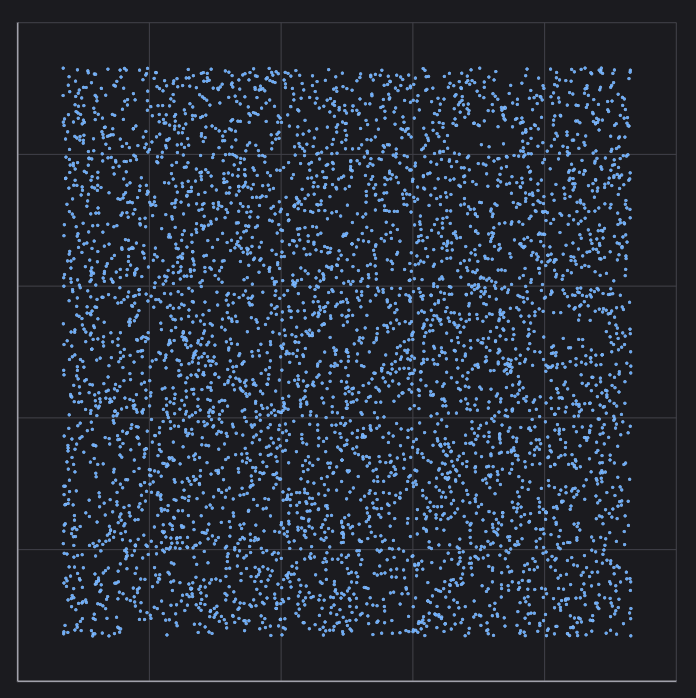
Example generated point set
Generates convex polygon.
std::vector< point< long long > > random_convex_polygon(int n, long long min_coord, long long max_coord, bool strict=false)
Generates a random convex polygon with given coordinate range.
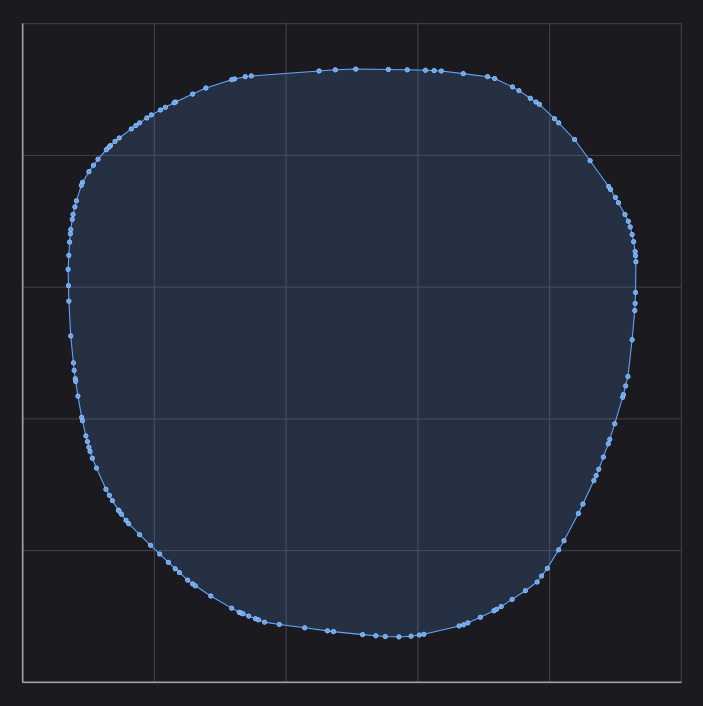
Example generated polygon
Generates a simple polygon.
std::vector< point< long long > > random_simple_polygon(int n, long long min_coord, long long max_coord, bool strict=false)
Generates a random simple polygon given coordinate range.
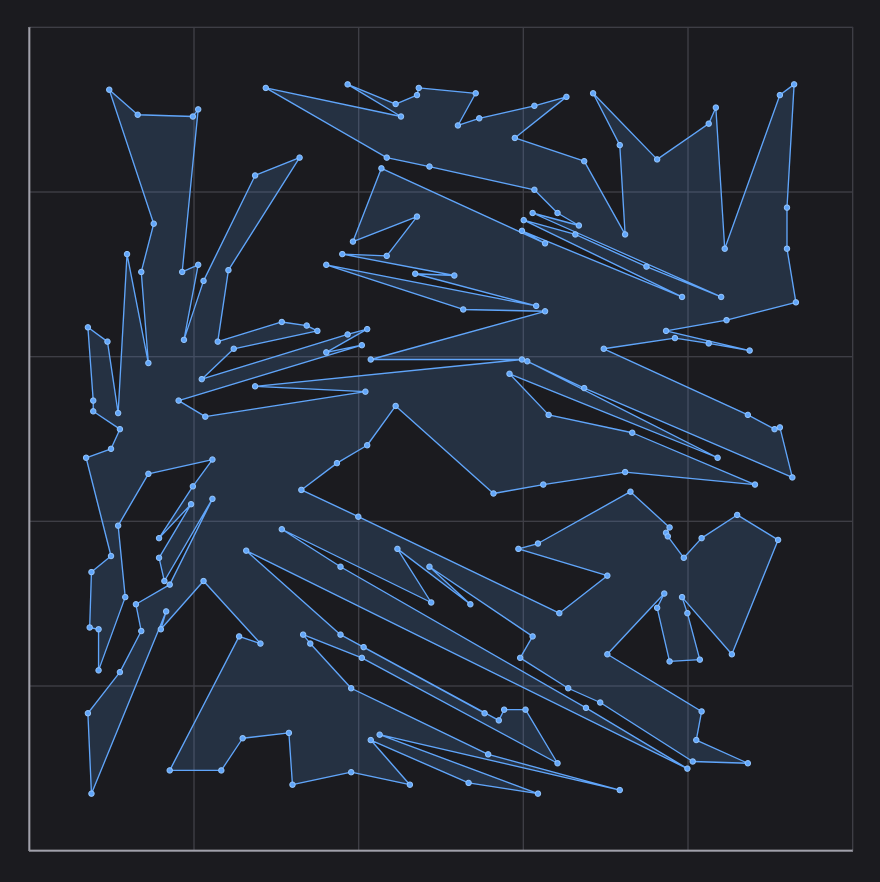
Example generated polygon
Simple polygon through a grid of points.
std::vector<tgen::geometry::point<long long>> pts;
for (int y = 0; y < 10; ++y)
for (int x = 0; x < 10; ++x)
pts.emplace_back(x, y);
std::vector< point< long long > > random_simple_polygon_through_points(const std::vector< point< long long > > &points)
Generates a random simple polygon through given points.
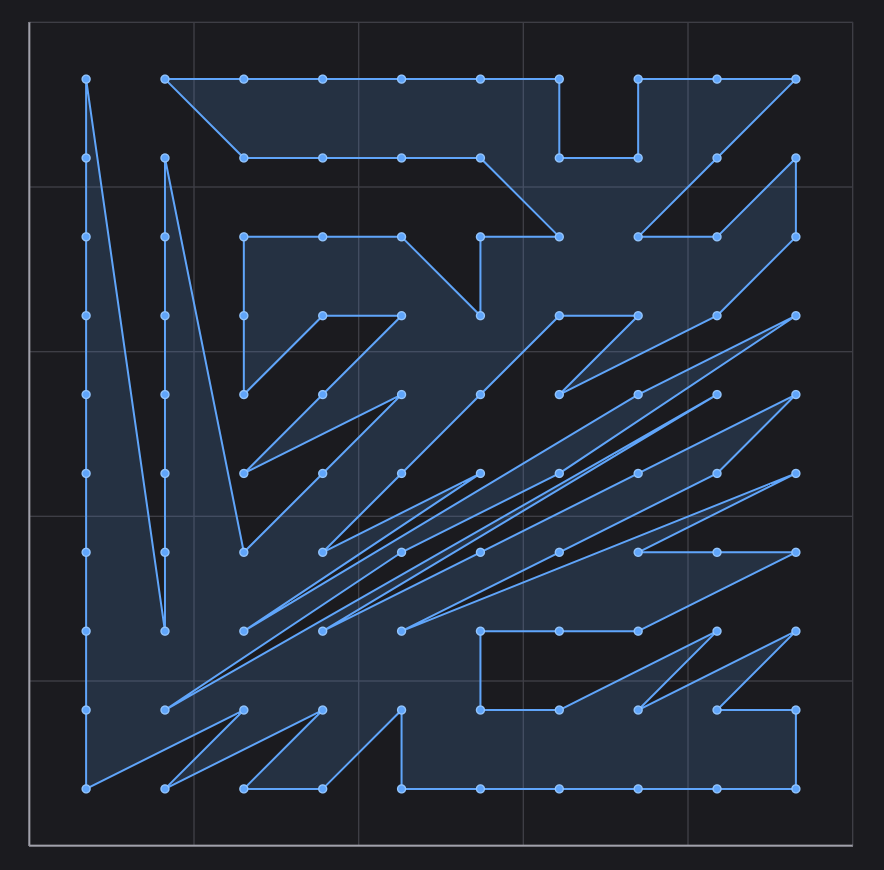
Example grid polygon
Generates a random orthogonal (axis-aligned) simple polygon.
std::vector< point< long long > > random_orthogonal_polygon(int n, long long min_coord, long long max_coord, bool strict=false)
Generates a random orthogonal simple polygon.
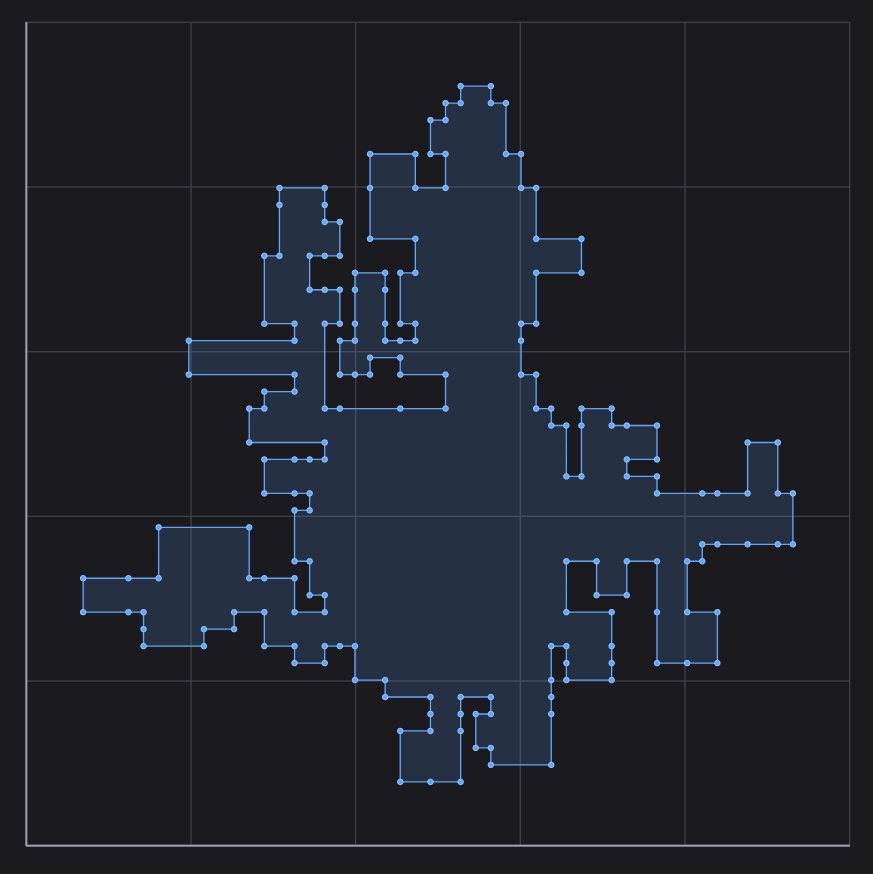
Example generated orthogonal polygon
◆ random_convex_polygon()
| std::vector< point< long long > > tgen::geometry::random_convex_polygon |
( |
int | n, |
|
|
long long | min_coord, |
|
|
long long | max_coord, |
|
|
bool | strict = false ) |
|
inline |
Generates a random convex polygon with given coordinate range.
- Parameters
-
| n | Number of vertices. |
| min_coord | Minimum allowed coordinate on each axis. |
| max_coord | Maximum allowed coordinate on each axis. |
| strict | If true, the polygon is strictly convex. If false, collinear vertices may occur. |
- Precondition
- n >= 3.
- Returns
- n distinct vertices of a convex polygon with integer coordinates in the inclusive square [min_coord, max_coord]^2, listed in counterclockwise order. When strict is true, the polygon is strictly convex.
Uses Valtr's classical construction: choose m distinct sorted x and y coordinates in [min_coord, max_coord] via tgen::distinct_range (with m = n when strict is false, and m > n when strict is true), build monotone signed edge components, shuffle the y-components, pair with the x-components, and sort by polar angle, then prefix-sum to obtain vertex coordinates. When strict is true, collinear boundary vertices are removed and the walk is subsampled to n vertices. The polygon is then translated by a random amount so it lies inside the requested box.
- Exceptions
-
| std::runtime_error | if the coordinate range is not large enough. |
- Warning
- When strict is true, the implementation retries a bounded number of times. Use a larger coordinate range if generation fails.
When strict is false, generation succeeds as long as max_coord - min_coord + 1 >= n.
- Note
- This operation is not uniformly random.
Time complexity
O(n log n).
Examples
Definition at line 7005 of file tgen.h.
◆ random_orthogonal_polygon()
| std::vector< point< long long > > tgen::geometry::random_orthogonal_polygon |
( |
int | n, |
|
|
long long | min_coord, |
|
|
long long | max_coord, |
|
|
bool | strict = false ) |
|
inline |
Generates a random orthogonal simple polygon.
- Parameters
-
| n | Target number of boundary vertices. |
| min_coord | Minimum allowed coordinate on each axis. |
| max_coord | Maximum allowed coordinate on each axis. |
| strict | If true, every vertex turns 90 degrees (no three consecutive collinear vertices). If false, collinear vertices may appear on straight horizontal or vertical edges. |
- Precondition
- n >= 4.
- Returns
- Vertices of a fully simple orthogonal polygon with axis-aligned edges, listed in counterclockwise order. When strict is false, the vertex count is exactly n. When strict is true, the count is at most n; for n <= 1000 it is often smaller because only boundary bumps are used; for n > 1000 it is near n.
The polygon is built in local steps that each preserve full simplicity (no edge crossings, overlaps, or boundary self-contact).
n <= 1000 bump on a square whose side is about sqrt(n):
- Start from a small axis-aligned square.
- Apply random inflate (outward tab, ~75% of accepted steps) and cut (inward notch, ~25%) operations on boundary subsegments. Each edit is accepted only if it keeps the boundary simple.
- When strict is true, remove collinear vertices.
- Loose: insert collinear vertices along straight edges until the count reaches n.
- Strict: stop once the count is at most n (often below n).
n > 1000 scale-up macro shape, then fill:
- Start from a small square (side between 8 and 64).
- Apply outward bumps only to obtain an irregular macro silhouette.
- Multiply all coordinates by an integer factor so the shape spans about (n+3)/4 per side.
- Loose: insert collinear vertices along edges until the count reaches n.
- Strict: insert outward depth-1 corrugation tabs along long edges until the count is near n (no collinear triples).
Finally, the polygon is translated into [min_coord, max_coord] (retrying up to 8 times if the bounding box is too large for the coordinate range) and cyclically shifted.
- Exceptions
-
| std::runtime_error | if the coordinate range is too small or no attempt fits inside the box. |
- Note
- This operation is not uniformly random.
Time complexity
O(n^2) for n <= 1000;
O(n) otherwise.
Examples
Definition at line 7728 of file tgen.h.
◆ random_points_general_position()
| std::vector< point< long long > > tgen::geometry::random_points_general_position |
( |
int | n, |
|
|
long long | min_coord, |
|
|
long long | max_coord ) |
|
inline |
Generates random points in general position inside a coordinate box.
- Parameters
-
| n | Number of points to generate. |
| min_coord | Minimum allowed coordinate on each axis. |
| max_coord | Maximum allowed coordinate on each axis. |
- Returns
- n distinct point<long long> values with integer coordinates in the inclusive square [min_coord, max_coord]^2 such that no three points are collinear.
The construction samples n distinct values (x, x^-1) from F_p then applies several random invertible shears over F_p, then translates the result into [min_coord, max_coord]^2. Affine maps preserve (non-)collinearity, and the graph of inversion over F_p meets any line in at most two points.
- Exceptions
-
| std::runtime_error | if the coordinate range is not large enough. |
- Note
- This operation is not uniformly random.
- Warning
- Modulo p, all generated points lie on one conic, an affine image of xy = 1. The random shears obscure the visual pattern but do not remove this structure. Combine this generator with other test families when that structure might make the tested problem easier.
Time complexity
O(n).
Examples
Definition at line 6602 of file tgen.h.
◆ random_simple_polygon()
| std::vector< point< long long > > tgen::geometry::random_simple_polygon |
( |
int | n, |
|
|
long long | min_coord, |
|
|
long long | max_coord, |
|
|
bool | strict = false ) |
|
inline |
Generates a random simple polygon given coordinate range.
- Parameters
-
| n | Number of vertices to generate. |
| min_coord | Minimum allowed coordinate on each axis. |
| max_coord | Maximum allowed coordinate on each axis. |
| strict | If true, the vertex set has no three collinear points. If false, there might be collinear triplets and three consecutive collinear points in the polygon. |
- Precondition
- n >= 3.
- Returns
- n distinct vertices listed in counterclockwise boundary order of a simple (non-self-intersecting) polygon. Coordinates lie in the inclusive square [min_coord, max_coord]^2.
When strict is true, the point set is built with random_points_general_position, othwerwise randomly generated. Points are polygonized by random_simple_polygon_through_points.
- Exceptions
-
| std::runtime_error | if the coordinate range is not large enough. |
- Note
- This operation is not uniformly random.
Time complexity
O(n log n) expected.
Examples
Definition at line 7706 of file tgen.h.
◆ random_simple_polygon_through_points()
| std::vector< point< long long > > tgen::geometry::random_simple_polygon_through_points |
( |
const std::vector< point< long long > > & | points | ) |
|
|
inline |
Generates a random simple polygon through given points.
- Parameters
-
- Precondition
- points.size() >= 3, all points are distinct, and they are not all collinear.
- Returns
- The same points listed in counterclockwise boundary order of a simple (non-self-intersecting) polygon.
Uses a randomized divide-and-conquer Hamiltonian-path construction on the leftmost and rightmost vertices.
- Note
- This operation is not uniformly random.
Time complexity
O(|points| log|points|) expected (if points are "random"), O(|points|^2) worst case.
Examples
Definition at line 7072 of file tgen.h.
 1.14.0